What Does the Sahara Desert Have in Common with the Amazon Rainforest?
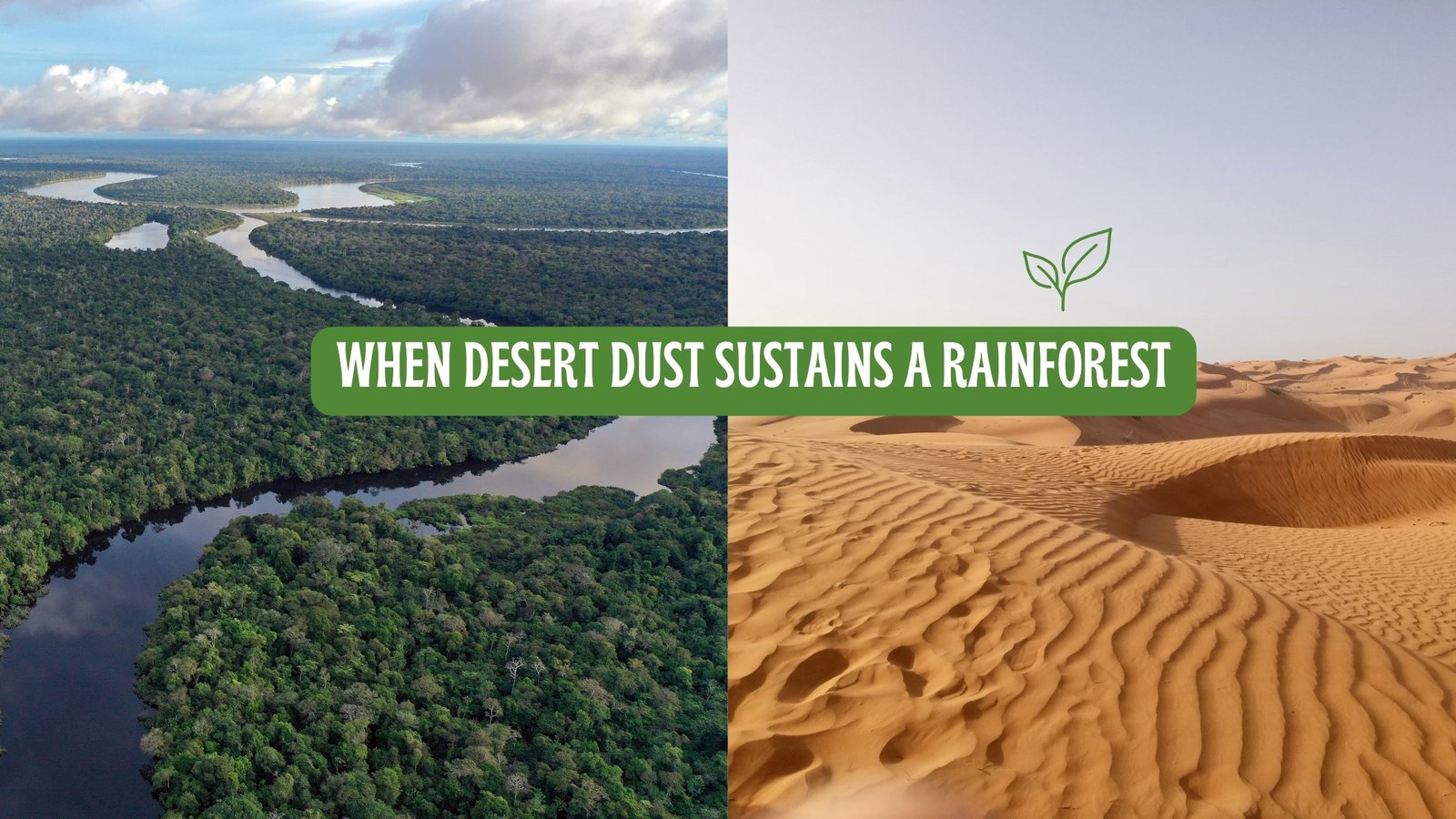
When we think of the Sahara Desert and the Amazon Rainforest, we usually imagine two completely different worlds. One is the largest hot desert on Earth, known for its vast sand dunes and extreme dryness. The other is the world’s largest tropical rainforest, famous for its incredible biodiversity and abundant rainfall.
Yet these two ecosystems are connected in a remarkable way.
A Journey Across the Atlantic
Every year, strong winds lift millions of tonnes of dust from the Sahara Desert and carry it thousands of kilometres across the Atlantic Ocean. This dust cloud travels from North Africa to South America, where a significant portion settles over the Amazon rainforest.
What makes this dust so important is not the sand itself, but the nutrients it contains.
The dust is rich in minerals such as phosphorus, a key nutrient that plants need to grow. Scientists have discovered that these airborne nutrients help replenish the Amazon’s soils, which constantly lose nutrients due to heavy rainfall and river runoff.
In other words, the Sahara helps fertilise the Amazon.
Why Soil Matters
Healthy soils are the foundation of healthy ecosystems. They store water, support biodiversity, recycle nutrients, and help plants grow.
The Amazon rainforest depends on a continuous supply of nutrients to sustain its immense biodiversity. Without nutrient inputs, including those delivered naturally through Saharan dust, the productivity of the ecosystem would be reduced.
This natural phenomenon reminds us that soil is not an isolated resource. Soil processes can connect ecosystems across continents and oceans.
Nature’s Global Recycling System
The movement of Saharan dust to the Amazon is one of Earth’s most impressive examples of nutrient recycling.
A dust particle lifted from North Africa can:
- Travel thousands of kilometres through the atmosphere.
- Deliver nutrients to rainforest soils.
- Support plant growth.
- Contribute to carbon storage.
- Influence global climate systems.
This demonstrates how interconnected our planet truly is.
Lessons for Sustainable Agriculture
For farmers and land managers, this story highlights an important lesson: nutrients must be continuously recycled to maintain healthy soils.
Regenerative agriculture embraces this principle through practices such as:
- Cover cropping.
- Composting.
- Reduced tillage.
- Crop rotation.
- Increasing soil organic matter.
These approaches help soils retain nutrients, support biodiversity, and improve resilience to climate change.
What Can We Learn from the Sahara and the Amazon?
The connection between the Sahara Desert and the Amazon Rainforest shows that even the most distant ecosystems can depend on one another.
It also reminds us that healthy soils are essential for life on Earth. Whether in deserts, forests, farms, or cities, protecting and restoring soil health is crucial for biodiversity, food security, and climate resilience.
At SOIL-XR, we explore innovative approaches to understanding and managing soil systems. The story of the Sahara and the Amazon is a powerful example of why soil should not be viewed as simply the ground beneath our feet, but as a living, dynamic resource that connects ecosystems across the globe.